Introduction to Secondary Surveillance Radar (SSR)
Secondary Surveillance Radar (SSR) is a radar system used in air traffic control (ATC) that relies on targets being equipped with a transponder. Unlike primary radar systems that detect and locate objects by reflecting radio signals off them, SSR requires aircraft to respond to interrogations with a coded reply signal.
Key Concept: SSR is a cooperative system where aircraft actively participate in their detection by responding to ground station interrogations.
Historical Development
SSR was developed during World War II as the Identification Friend or Foe (IFF) system to distinguish between friendly and enemy aircraft. After the war, the technology was adapted for civilian air traffic control, evolving into the modern SSR system.
Primary Radar vs. Secondary Radar
| Feature |
Primary Radar |
Secondary Radar |
| Principle |
Reflection of transmitted signals |
Interrogation and response |
| Target Cooperation |
Not required |
Required (transponder) |
| Information Provided |
Range and bearing only |
Range, bearing, altitude, identity |
| Range |
Limited by reflected signal strength |
Greater range due to active response |
| Weather Interference |
Significant (clutter) |
Minimal |
| Power Requirements |
High transmission power |
Lower transmission power |
Primary vs Secondary Radar Operation
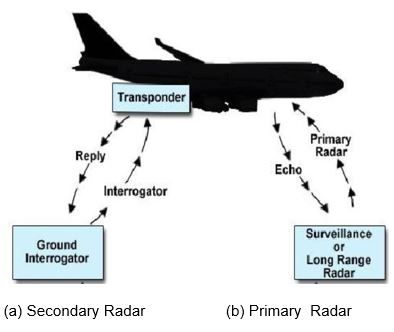
Primary radar relies on signal reflection, while secondary radar uses active transponder responses.
Modes of Operation
Mode A (Identity Mode)
Mode A interrogations request a 4-digit transponder code (squawk code) set by the pilot. This provides aircraft identification but no altitude information.
Mode C (Altitude Mode)
Mode C interrogations request the aircraft's pressure altitude, which is automatically provided by the aircraft's altitude encoder. This allows ATC to determine the aircraft's flight level.
Mode S (Selective Mode)
Mode S is an enhanced SSR system that provides:
- Selective addressing of individual aircraft
- Data link capability for exchange of additional information
- Reduced frequency congestion
- Collision avoidance support (TCAS)
Technical Note: Mode S uses a 24-bit aircraft address that uniquely identifies each aircraft worldwide.
Interrogation Frequencies
SSR interrogations are transmitted at 1030 MHz, while transponder replies are transmitted at 1090 MHz.
Distance Measuring Equipment (DME)
Distance Measuring Equipment (DME) is a radio navigation technology that measures the slant range distance between an aircraft and a ground-based transponder. DME is often collocated with VOR stations (forming VOR/DME) or as part of an Instrument Landing System (ILS).
DME Operation Principle
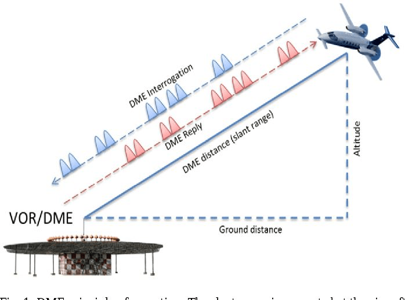
DME calculates distance by measuring the time delay between interrogation and response.
DME Operating Frequencies
DME operates in the UHF frequency band from 960 MHz to 1215 MHz. The system uses paired channels with 1 MHz separation between interrogation and reply frequencies.
DME System Operation
Principle of Operation
DME measures distance by calculating the time taken for a radio signal to travel from the aircraft to the ground station and back. The aircraft's DME interrogator transmits pulse pairs to the ground station, which responds after a fixed delay (typically 50 microseconds).
Distance = (Time Delay - Fixed Delay) × Speed of Light ÷ 2
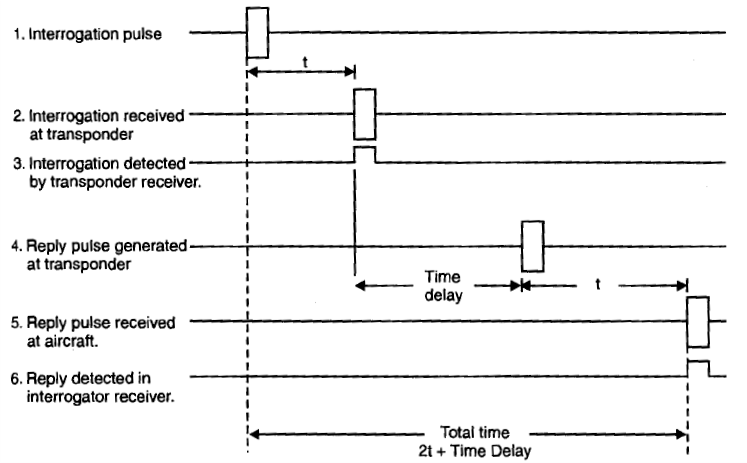
Figure: How DME calculates range as R = c x
(2t–td)
System Components
- Aircraft Interrogator: Transmits interrogation signals and processes replies
- Ground Transponder: Receives interrogations and transmits replies
- Antennas: Both aircraft and ground station have dedicated antennas
- Control Unit: Interface for pilot to select channels
- Display: Shows distance (and sometimes ground speed and time to station)
DME Channels
The DME system uses 252 channels (1-126X and 1-126Y) with specific frequency pairings. Aircraft automatically tune to the correct DME frequency when a VOR or ILS frequency is selected.
Important: DME measures slant range, not horizontal distance. At close ranges and high altitudes, this difference can be significant.
Accuracy and Limitations
Typical DME systems have an accuracy of ±0.1 nautical miles or 3% of the distance, whichever is greater. The maximum range is typically about 200 nautical miles, limited by line-of-sight propagation.
Knowledge Check Quiz
1. What is the fundamental difference between primary and secondary radar?
A) Primary radar uses higher frequencies
B) Secondary radar requires target cooperation
C) Primary radar provides more information
D) Secondary radar has shorter range
2. What frequencies are used for SSR interrogations and replies?
A) 1030 MHz interrogation, 1090 MHz reply
B) 1090 MHz interrogation, 1030 MHz reply
C) 960 MHz interrogation, 1215 MHz reply
D) 1215 MHz interrogation, 960 MHz reply
3. Which SSR mode provides aircraft altitude information?
A) Mode A
B) Mode B
C) Mode C
D) Mode D
4. How does DME calculate distance between aircraft and ground station?
A) By measuring signal strength
B) By measuring phase difference
C) By measuring round-trip time
D) By measuring Doppler shift
5. What is a key advantage of Mode S over earlier SSR modes?
A) It uses lower frequencies
B) It provides selective addressing of aircraft
C) It requires less power
D) It has shorter range
Answers: 1-B, 2-A, 3-C, 4-C, 5-B